A Global Moment for the Image | The Sony World Photography Awards in Johannesburg

For the first time in South Africa, the Sony World Photography Awards have arrived in Johannesburg with Decisive Moment, a landmark exhibition at the Roger Ballen Centre for Photography.
Bringing together award-winning and shortlisted work from the 2024, 2025 and 2026 editions of the Awards, the exhibition presents 34 photographers from 17 countries. Documentary, portraiture, sport, wildlife, travel and creative photography converge to offer a far-reaching view of contemporary photography and of the world being photographed today.
The international scale of the Awards is extraordinary. The 2026 edition alone received more than 430,000 entries from over 200 countries and territories, affirming its position as one of the world’s most significant celebrations of photography. From this vast global platform, Decisive Moment brings a carefully selected body of work to Johannesburg, creating a rare opportunity to encounter diverse lives, landscapes and visual languages within a single exhibition.
Running concurrently, New Eyes highlights the vitality of emerging South African photography alongside these international award-winning works.
Despite their geographic and stylistic differences, the exhibiting photographs can be understood through three interconnected concerns: People and Planet; Identity and Belonging; and History and Resistance.

People and Planet
Across the exhibition, photographers examine the increasingly fragile relationship between human life and the natural world.
In In the Footsteps of Giants, Jasper Doest documents the complex coexistence of rural communities and elephants in Zambia. As settlements and agriculture expand into animal habitats, competition for limited resources intensifies. The series asks what economical and social sustainable coexistence might look like for both wildlife and local communities.
Environmental change is also central to Skander Khlif’s Where Dust and Water Dream Together. Set in Tunisia, the project considers a landscape in which desert sands encroach upon fertile land and rising seas reshape the coastline. Rather than presenting climate change as a distant catastrophe, Khlif explores it as an ongoing transformation affecting traditions and livelihoods.
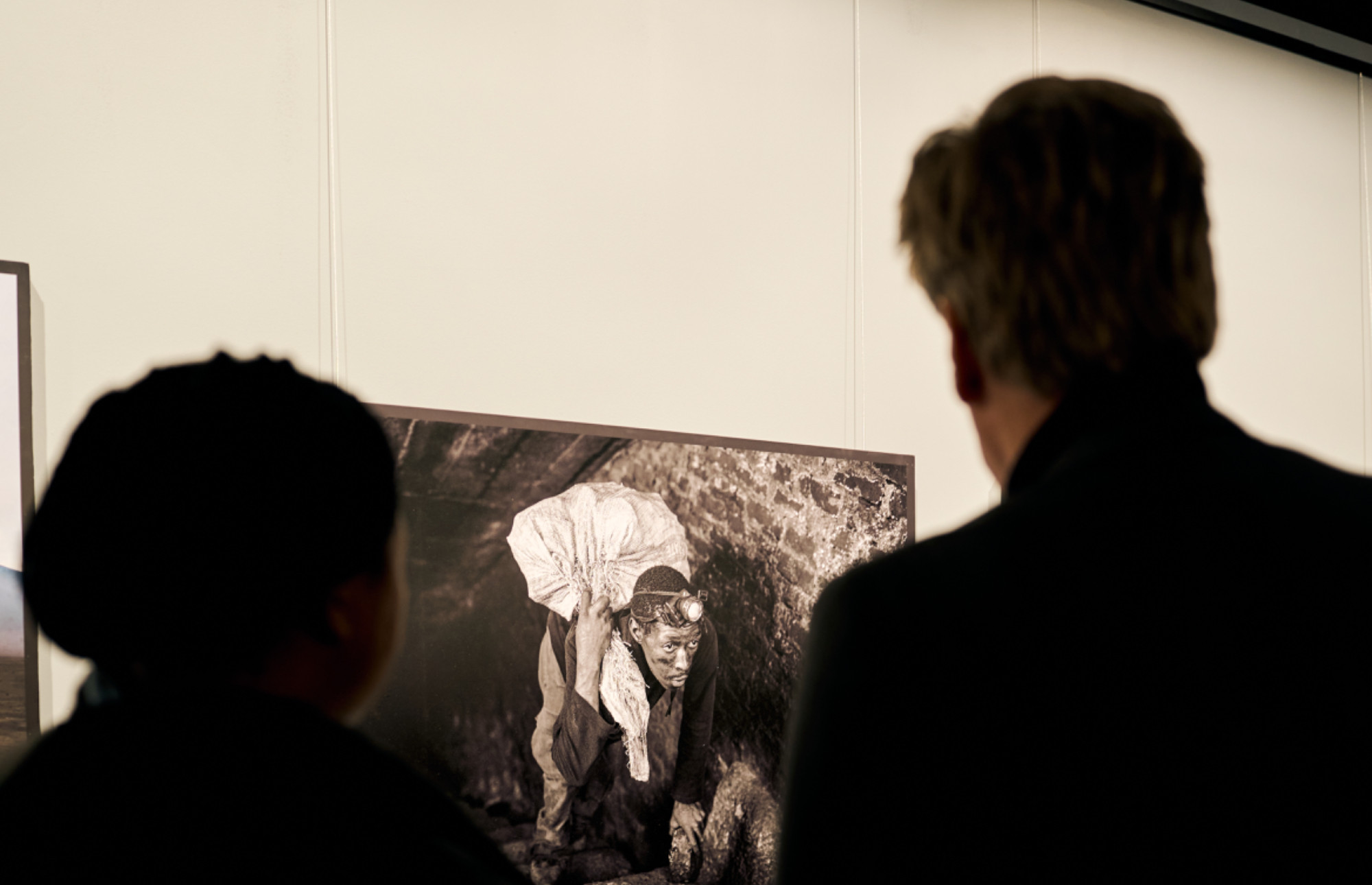
Closer to home, Per-Anders Pettersson’s documentation of coal communities in Mpumalanga reflects the difficult realities surrounding South Africa’s transition towards cleaner energy. While the shift is environmentally necessary, hundreds of thousands of people remain dependent on the coal industry. His photographs reveal that the future of energy cannot be separated from questions of labour, economic survival and social responsibility.

Other projects offer intimate views of conservation in action. Will Burrard-Lucas used a remote camera trap to photograph endangered black rhinoceroses and other animals moving through a protected corridor in Kenya’s Maasai Mara. Thomas Nicolon documents the conservation of the Congo dwarf crocodile, while Elle Leontiev’s portrait of a self-taught volcanologist in Vanuatu captures a life shaped by close proximity to an active natural force. Zed Nelson’s The Anthropocene Illusion exposes South Africa’s captive-lion industry, where animals raised for tourist encounters are later sold for trophy hunting and the lion-bone trade.
Together, these photographs ask how we might live more responsibly within the landscapes and ecosystems we continue to transform.
Identity and Belonging
Throughout Decisive Moment, photography becomes a way of exploring how people understand themselves and how belonging is created through family, place, history, and shared experience.
Toby Binder’s Divided Youth of Belfast follows young people growing up in Protestant and Catholic neighbourhoods decades after the Northern Ireland peace agreement. Although this generation did not experience the conflict directly, physical barriers and inherited divisions continue to influence their daily lives. The series reflects on how identities can be shaped by histories that precede us, as well as by something as arbitrary as the street into which we are born.
Julian Cabral approaches identity through the intimate space of family. In Triplets, he documents himself and his two brothers as they move from a life defined by shared experiences towards increasingly independent futures. Alice Poyzer’s Other Joys similarly turns the camera inward. Through staged self-portraits, she creates a visual language for autistic identity and the pressures of adapting oneself to social expectations.
Tradition offers another form of continuity and belonging. Aakash Gulzar photographs Kashmir’s pigeon keepers, for whom the daily rituals of feeding and training birds provide peace and stability during uncertain times. Hajime Hirano’s Mask considers Japanese religious rites threatened by depopulation and modernisation, while Keiichiro Muramatsu draws upon the structure of haiku to explore stillness and negative space. Thapelo Mahlangu’s Rebirth: The Ritual of Baptism examines spiritual renewal within Xhosa cultural traditions.
Sport, music and subculture also emerge as spaces through which communities are formed. Luis Tato documents the growing culture surrounding Nairobi Polo Club and Tommaso Pardini follows an aspiring surfer in Dakar. In KwaZulu-Natal, Sandile Ndlovu’s Blowing Away the Blues shows how the Mthwalume Brass Band uses music to nurture young talent and strengthen community.
This conversation finds a particularly important South African expression in the New Eyes: An Award for Emerging South African Photographers.
D. M. Terblanche’s I Should Have Burnt More Cars uses narrative documentary photography to explore late-diagnosed autism, queer identity and the difficulty of making sense of experiences without the language to name them. Zwelibanzi Zwane’s Ukuthula, meaning “peace,” transforms a period of rehabilitation and reflection into a meditative exploration of memory and personal growth.
Karabo Mooki’s Amandla and Dogg Pound Days document communities formed through skateboarding and Soweto’s punk scene. His photographs show young people creating their own spaces of expression and solidarity while redefining who is permitted to belong within particular cultural movements.
Across these bodies of work, identity is not treated as something automatically given. It is inherited and continually remade through the relationships and communities people build around themselves.

History and Resistance
The exhibition’s third pillar considers photography as a means of confronting political structures, contested histories and unequal systems of power.
Colin Delfosse’s Restitution traces the movement of African masks between the Democratic Republic of the Congo and Belgium. Combining archival material and contemporary photography, the project questions the colonial histories through which cultural objects entered European collections. It asks what it means to exhibit, return or reactivate objects whose histories remain inseparable from displacement and institutional authority.
Pablo Ramos’s The Black Album intervenes in archival photographs to reflect on widespread disappearance and unresolved loss in Mexico. Rather than documenting events directly, Ramos uses the archive to represent absence, creating a collective portrait of people who are no longer visible within the family album.
In Before Tomorrow, Lorraine Turci centres women in The Gambia rebuilding their lives and advocating for accountability following years of dictatorship and institutional silence. Matteo Bastianelli photographs communities in Mozambique facing the combined pressures of conflict, displacement, poverty and escalating environmental disasters. Santiago Mesa’s Under the Shadow of Coca examines coca cultivation in rural Colombia, complicating narratives that overlook the economic desperation, weak state presence and armed control shaping the choices available to farming communities.
Resistance also appears through everyday acts of movement, creativity and solidarity. Chantal Pinzi’s Shred the Patriarchy follows women skateboarders in India who challenge restrictive gender roles and reclaim public space. Antonio López Díaz documents young gymnasts from Chad whose pursuit of the Olympic Games helped inspire the creation of their country’s first gymnastics federation.
These photographers do more than record inequality or conflict. Their images reveal how people respond to systems of power: by questioning dominant narratives and claiming the right to define their own futures.

A Global Conversation in Johannesburg
Decisive Moment and New Eyes bring together photographs of exceptional quality, each revealing a perspective or experience that demands a closer look. Presented together in Johannesburg, these exhibitions offer a rare opportunity to encounter some of the world’s most compelling contemporary photography alongside bold emerging voices from South Africa.
We invite you to visit, spend time with the images and experience for yourself what photography can reveal.
Decisive Moment was made possible through the generous support of CREO, the World Photography Organisation and the Sony Africa team.
The Sony World Photography Awards 2027 are now open for submissions. Visit worldphoto.org for full entry information.


Comments