Fashion_The Image: A Harbinger Of What's To Come

Words by Anele Nyanda
There is a quiet poetry in the way fashion and photography coalesce, the way fabric finds permanence through the lens, and the way the camera discovers narrative within the textures, silhouettes, and gestures that constitute a garment. This poetry is not only something to be observed it is something one needs to walk and “live” through.
To step into Fashion_The Image is to be pulled into motion, to be awakened. The photographs in the room do not unfold gently, they surround you. Large-scale photographs line the walls, their scale collapsing the space around you until you are fully immersed within the images. Their presence immediate and commanding, the garments within them seeming to spill into the space itself. Standing at the centre of the room feels almost orchestral, as if each image were an instrument within a carefully composed score, distinct in tone, colour, and rhythm, yet held together in a larger visual harmony.
To stand within this exhibition as an artist, as an ordinary observer, but especially as a photographer or designer, is to feel something shift internally.The curation of the images refuses the current crisis of sameness that has plagued the artists of today and resulted in prosaic work. In a world saturated by images, where photographs are easily produced and quickly forgotten, the act of image-making can begin to feel mechanical, driven more by visibility than by intention. There is a quiet pressure to keep up, to conform, to create work that aligns with what is popular, polished, and easily consumed, a pressure shaped by the broader crisis of sameness, where algorithms and market forces begin to favour what is familiar and trendy over what is thoughtful. It is, as Albert Camus writes, a kind of din, one in which “the artist cannot hope to remain aloof in order to pursue the reflections and images that are dear to him.” And yet, within this exhibition space that pressure, that crisis of sameness begins to loosen its hold on artists. Here, sameness is refused. The curation holds space for difference, allowing multiplicity to exist without hierarchy. The works do not conform to a singular aesthetic, they expand outward and provide aesthetic risks, holding space for experimentation, contradiction, and multidimensionality, ipso facto giving rise to the Africanisation of not only photography and fashion, but of curation itself, shaping how these practices are conceived, presented, and experienced. In this way, the exhibition’s curation and image selection stand as a clear harbinger of what’s to come.
It is within this multiplicity that the exhibition begins to reveal something deeper. The images do not exist in isolation, they are anchored in the garments they present and in the designers whose stories they carry. To engage with Fashion_The Image, is not only to engage with photography, but with the layered relationship between garment, body, and image.
To speak of garments in this context is also to speak of the designers behind them, their histories, intentions, and the narratives embedded within each piece. Clothing is never just clothing, it carries meaning, and in wearing it, we carry that meaning with us. We are in many ways wearing the designer’s story, choosing garments not only for how they look, but for what they represent and how they resonate with our own identities. This significance is rooted in something deeply physical. Fabric is the closest thing to our skin, the immediate layer through which we move through the world, the surface that both conceals and reveals. It is through this proximity that clothing and design gains its power. It holds traces of who we are, how we see ourselves, and how we dare to be seen. To engage with clothing, then, is to engage with a second skin one that carries both personal and cultural meaning.
It is through photography that the meaning of a garment is either deepened or diminished. The camera does not simply capture the garment, it mediates it. Through composition, environment, and context, the photographer has the power to allow the garment to exist fully within its meaning and to inhabit a space that honours its origin,intention, and the narratives it carries. This becomes evident in the photographic work produced for UNIFORM’s AW24 collection by photographer Aart Verrips titled Not Just Here, But Here and Everywhere Else.
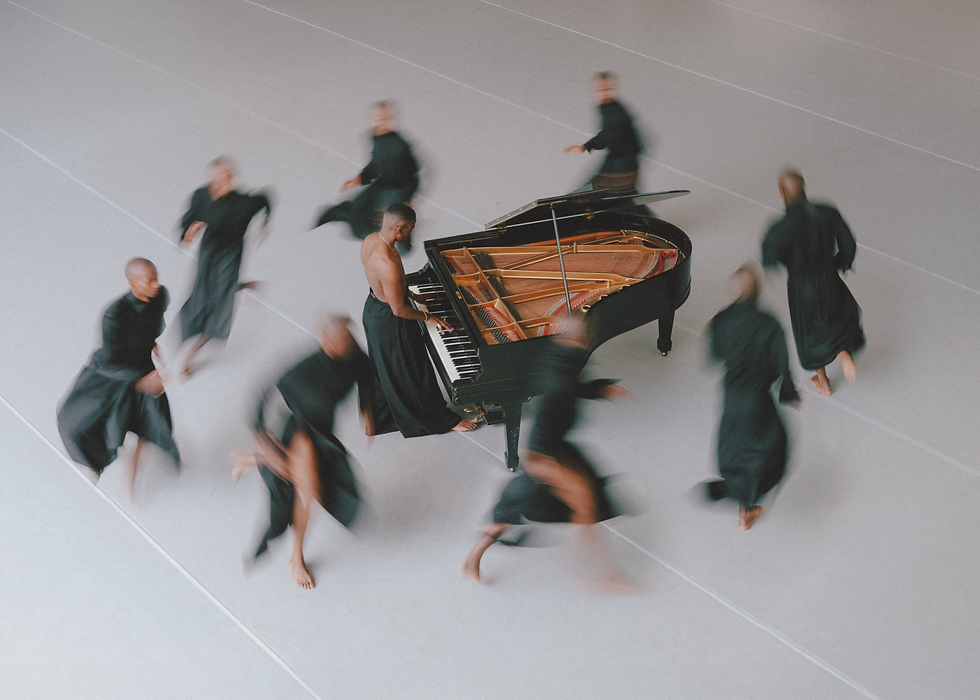
In this image a solitary figure stands at a grand piano, composed and still, while blurred bodies circulate around him figures that move like echoes, their garments dissolving into gesture. The image resists stillness, even in its stillness. It feels like a distinct energy one feels living in Johannesburg. A city moving so fast that even when one is still, everything else is in motion. A city defined by pace, urgency, the constant rhythm of people moving, working, building, surviving - a place of arrival which in this image is reflected by the man still in the middle and ambition reflected by those moving around him. This energy is embedded within the photograph. The blurred figures do not simply suggest movement, they evoke a lived condition. The central figure becomes a point of pause within this velocity, a moment of stillness held against the relentless movement that surrounds him. The photographer composes not just an image but a world, one in which the garment is embedded within rhythm,environment and the lived realities of the city itself. To photograph in this way is to work in dialogue with the garment and its context rather than against it. The image does not impose meaning but allows meaning to unfold, situating the clothing within a space that reflects both its design ethos and the conditions of the world it inhabits. In doing so, the photograph restores depth to the garment, allowing it to exist not only as fashion, but as something lived, carried, and continuously shaped by the movement of the world around it.
This relationship between garment and image also becomes especially evident in the photographic presentation of Thebe Magugu’s work by Pieter Hugo.

Seen in person, the photograph feels almost architectural. The photograph is stripped of distraction in the background leaving all attention in the foreground, allowing the geometry of the fabric to command attention. The vertical stripes cascade like architectural lines, and through the lens the garment transforms from clothing into structure, something monumental, almost architectural in its presence. The cool palette of blues and whites invites clarity and control to your eye, while the photographer’s restrained composition allows the viewer to focus on the “rhythm” of the pleats and the silhouette they create. Here, photography is an act of translation, the camera does not simply record the garment but reveals its spatial logic, its agility, and the quiet power of its form.
The images,printed at an imposing scale, insist on presence, transforming garments into something larger than fashion, into form, narrative, and cultural expression. Moving through the exhibition, you become aware of how each photograph holds the room differently. Some images draw you closer through their restraint, while others announce themselves through colour, scale, and composition. Together, they create a visual melody, a carefully curated arrangement where distinct photographic voices coexist while shaping a shared atmosphere.
Moving through the exhibition, the deliberate nature of the curation becomes increasingly apparent. The works are not arranged to elevate a singular aesthetic or voice, but rather to reveal the vast diversity within African fashion photography. Each photograph introduces a different visual language, a different relationship between body, garment and environment. The photographs of Thebe Magugu’s garments exist within this broader conversation, but they are only one voice among many. Nearby, the works of Ntsikelelo Veleko and Lerato Mbhawa unfold in strikingly different and audacious ways through shifts in colour, environment, personality, and atmosphere.


The work of Ntsikelelo shifts the register entirely, grounding the garment within a different, yet equivalently powerful visual and cultural language. The garment is not suspended within abstraction or choreography, but anchored in a lived, recognisable environment. A young figure stands confidently against a weathered wall marked by the painted face of Steve Biko, a presence that I feel is not incidental nor decorative, but deeply symbolic. Biko, as a central figure in the Black Consciousness Movement, becomes more than backdrop, he becomes a silent interlocutor within the image, situating the garment and imagery within a lineage of pride, resistance, and self-definition.
The suit itself - bold, floral, textured and unapologetically vibrant, refuses the muted codes often associated with Eurocentric notions of elegance. It does not seek subtlety, it announces itself. In doing so it reflects a distinctly African relationship to clothing, one that embraces pattern, colour, and exaggeration as forms of expression rather than excess. The garment, designed by FDB Human Store, carries with it the textures of its origin in Soweto, a place deeply embedded in histories of resistance, community, and cultural production. This context is not external to the garment. It is integral to it.
What is striking is not only the garment, but the body that inhabits it. The figure stands with a quiet certainty, unpolished and unmediated by the conventions of a high-fashion model. This refusal of conventionality does not feel like limitation, but a deliberate expansion. The photographer composes a space in which the garment can exist within its cultural and historical consciousness, allowing it to resonate beyond aesthetics and into identity. The image does not aspire to a singular definition of fashion photography, instead it asserts that fashion photography can and must be vast.
Placed alongside more restrained, conceptual works within the exhibition this image becomes part of a larger curatorial gesture, one that refuses hierarchy. It insists that fashion photography does not belong solely to polished studios, high-end designers, or globally sanctioned aesthetics. It belongs equally to the streets, to memory, to history, to bodies that do not conform, and to garments that speak proudly. In this way, the work becomes a declaration. A reminder that African fashion and photography have never been one dimensional, and must never be made to be.
Walking through the room, you encounter these differences not as contradictions, but as evidence of the multiplicity of African photographic practice. What becomes apparent is that there is no singular way to photograph African fashion.
Photographers like Paul Shiakallis allow textiles and silhouettes to dominate the frame, transforming garments into sculptural forms. Others construct vivid environments where colour, backdrop, and pattern extend the narrative of the clothing itself. In each case, the clothing remains central not simply as design, but as language.


Standing within the exhibition, you begin to see how these different photographic approaches form a collective statement. The diversity of styles, quiet and restrained, theatrical and saturated, reveals an ecosystem of creative voices shaping the future of African visual culture. Rather than presenting a singular definition of fashion photography, Fashion_The Image has opened a space where multiple interpretations of fashion photography coexist. It is precisely this multiplicity that makes the exhibition feel like a harbinger of what’s to come, a glimpse into a future where African fashion photography continues to expand, evolve and speak through many distinct yet interconnected visual languages.
This essay forms part of the Fashion_The Image :
Writer-in-Residence programme, developed by the Roger Ballen Centre for Photography in partnership with AFRI.digital and Wanted Online. The programme invited emerging writers to engage critically with the exhibition through research, conversation, and direct engagement with the exhibition and its public programming.
Written by Anele Nyanda as part of the residency, A Harbinger Of What’s To Come reflects on the multiplicity of African fashion photography and the role image-making plays in shaping cultural expression and visual language.
This opportunity was made possible by the National Arts Council.


Comments